Tag Archives: family

Millionaire to Millennials: Buy Now!

Millionaire to Millennials: Buy Now! | Simplifying The Market

Self-made millionaire David Bach was quoted in a CNBC article explaining that “the single biggest mistake millennials are making” is not purchasing a home because buying real estate is “an escalator to wealth.”

Bach went on to explain:

“If millennials don’t buy a home, their chances of actually having any wealth in this country are little to none. The average homeowner to this day is 38 times wealthier than a renter.”

In his bestselling book, “The Automatic Millionaire,” Bach does the math:

“As a renter, you can easily spend half a million dollars or more on rent over the years ($1,500 a month for 30 years comes to $540,000), and in the end wind up just where you started — owning nothing. Or you can buy a house and spend the same amount paying down a mortgage, and in the end wind up owning your own home free and clear!”

Who is David Bach?

Bach is a self-made millionaire who has written nine consecutive New York Times bestsellers. His book, “The Automatic Millionaire,” spent 31 weeks on the New York Times bestseller list. He is one of the only business authors in history to have four books simultaneously on the New York Times, Wall Street Journal, BusinessWeek and USA Today bestseller lists.

He has been a contributor to NBC’s Today Show appearing more than 100 times, has been a regular on ABC, CBS, Fox, CNBC, CNN, Yahoo, The View, and PBS, and has been profiled in many major publications, including The New York Times, BusinessWeek, USA Today, People, Reader’s Digest, Time, Financial Times, The Washington Post, The Wall Street Journal, Working Woman, Glamour, Family Circle, Redbook, Huffington Post, Business Insider, Investors’ Business Daily, and Forbes.

Bottom Line

Whenever a well-respected millionaire gives investment advice, people usually clamor to hear it. This millionaire gave simple advice – if you don’t yet live in your own home, go buy one.


Renting or Buying… Either way you are paying a mortgage

Renting or Buying… Either Way You’re Paying a Mortgage | Simplifying The Market

There are some people who have not purchased homes because they are uncomfortable taking on the obligation of a mortgage. Everyone should realize that, unless you are living with your parents rent-free, you are paying a mortgage – either yours or your landlord’s.

As Entrepreneur Magazine, a premier source for small business, explained this month in their article, “12 Practical Steps to Getting Rich”:

While renting on a temporary basis isn’t terrible, you should most certainly own the roof over your head if you’re serious about your finances. It won’t make you rich overnight, but by renting, you’re paying someone else’s mortgage. In effect, you’re making someone else rich.”

Christina Boyle, Senior Vice President and head of the Single-Family Sales & Relationship Management organization at Freddie Mac, explains another benefit of securing a mortgage vs. paying rent:

“With a 30-year fixed rate mortgage, you’ll have the certainty & stability of knowing what your mortgage payment will be for the next 30 years – unlike rents which will continue to rise over the next three decades.”

As an owner, your mortgage payment is a form of ‘forced savings’ which allows you to build equity in your home that you can tap into later in life. As a renter, you guarantee the landlord is the person with that equity.

Interest rates are still at historic lows, making it one of the best times to secure a mortgage and make a move into your dream home. Freddie Mac’s latest report shows that rates across the country were at 4.23% last week.

Bottom Line

Whether you are looking for a primary residence for the first time or are considering a vacation home on the shore, now may be the time to buy.

It’s a Sellers Market! Should I Downsize Now?

It's a Seller's Market! Should I Downsize Now? | Simplifying The Market

It’s a Seller’s Market! Should I Downsize Now?

A study by Edelman Berland reveals that 33% of homeowners who are contemplating selling their houses in the near future are planning to scale down. Let’s look at a few reasons why this might make sense for many homeowners, as the majority of the country is currently experiencing a seller’s market.

In a blog, Dave Ramsey, the financial guru, highlighted the advantages of selling your current house and downsizing into a smaller home that better serves your current needs. Ramsey explains three potential financial advantages to downsizing:

  1. A smaller home means less space, but it also means less time, stress and money spent on upkeep.
  2. Let’s assume you save $500 a month on your mortgage payment. In 30 years, you could have an additional $1–1.6 million in the bank to get you through your golden years.
  3. Use the proceeds from selling your current home to pay cash for a smaller one. Just imagine what you could do with no mortgage holding you down! If you can’t pay cash, aim for a 15-year fixed rate mortgage and put at least 10–20% down on your new home. Apply the $500 you saved from downsizing to your new monthly payment. At 3% interest, you could pay off a $200,000 mortgage in less than 10.5 years, saving almost $16,000 in the process.

Realtor.com also addressed downsizing in an article. They suggest that you ask yourself some questions before deciding if downsizing is right for you and your family. Here are two of their questions followed by their answers (in italics) and some additional information that could help.

Q: What kind of lifestyle do I want after I downsize?

A: “For some folks, it’s a matter of living a simpler life focused on family. Some might want to cross off travel destinations on their bucket lists. Some might want a low-maintenance community with high-end upgrades and social events. Decide what you want to achieve from your move first, and you’ll be able to better narrow down your housing options.”

Comments: Many homeowners are taking the profits from the sales of their current homes and splitting it in order to put down payments on smaller homes in their current locations, as well as on vacation/retirement homes where they plan to live when they retire.

This allows them to lock in the home price and mortgage interest rate at today’s values which makes sense financially as both home prices and interest rates are projected to rise.

Q: Have I built up enough equity in my current home to make a profit?

A: “For most homeowners, the answer is yes. This is if they’ve held on to their properties long enough to have positive equity that will be sizable enough to put a large down payment on their next home.”

Comments: A study by Fannie Mae revealed that only 37% of Americans believe that they have significant equity (> 20%) in their current home. In actuality, CoreLogic’s latest Equity Report revealed that 78.9% have greater than 20% equity. That equity could enable you to build the life you’ve always dreamt about.

Bottom Line

If you are debating downsizing your home and want to evaluate the options you currently have, let’s meet up to help guide you through the process.

Which Home Have Appreciated the Most?

Which Homes Have Appreciated the Most? | Simplifying The Market

Home values have risen dramatically over the last twelve months. The latest Existing Home Sales Report from the National Association of Realtors puts the annual increase in the median existing-home price at 7.1%. CoreLogic, in their most recent Home Price Insights Report, reveals that national home prices have increased by 6.9% year-over-year.

The CoreLogic report broke down appreciation even further into four different price categories:

  1. Lower Priced Homes: priced at 75% or less of the median
  2. Low-to-Middle Priced Homes: priced between 75-100% of the median
  3. Middle-to-Moderate Priced Homes: priced between 100-125% of the median
  4. High Price Homes: priced greater than 125% of the median

Here is how each category did in 2016:

Which Homes Have Appreciated the Most? | Simplifying The Market

Bottom Line

The lower priced homes (which are more in demand) appreciated at greater rates than the homes at the upper ends of the spectrum.

A Tale of Two Markets….

A Tale of Two Markets: Inventory Mismatch Paints a More Detailed Picture | Simplifying The Market

A Tale of Two Markets: Inventory Mismatch Paints a More Detailed Picture

The inventory of existing homes for sale in today’s market was recently reported to be at a 3.6-month supply according to the National Association of Realtors latest Existing Home Sales Report. Inventory is now 7.1% lower than this time last year, marking the 20th consecutive month of year-over-year drops.

Historically, inventory must reach a 6-month supply for a normal market where home prices appreciate with inflation. Anything less than a 6-month supply is a sellers’ market, where the demand for houses outpaces supply and prices go up.

As you can see from the chart below, the United States has been in a sellers’ market since August 2012, but last month’s numbers reached a new low.

A Tale of Two Markets: Inventory Mismatch Paints a More Detailed Picture | Simplifying The Market

Recently Trulia revealed that not only is there a shortage of homes on the market in general, but the homes that are available for sale are not meeting the needs of the buyers that are searching.

Homes are generally bucketed into three groups by price range: starter, trade-up, and premium.

Trulia’s market mismatch score measures the search interest of buyers against the category of homes that are available on the market. For example: “if 60% of buyers are searching for starter homes but only 40% of listings are starter homes, [the] market mismatch score for starter homes would be 20.”

The results of their latest analysis are detailed in the chart below.

A Tale of Two Markets: Inventory Mismatch Paints a More Detailed Picture | Simplifying The Market

Nationally, buyers are searching for starter and trade-up homes and are coming up short with the listings available, leading to a highly competitive seller’s market in these categories. Ninety-two of the top 100 metros have a shortage in trade-up inventory.

Premium homebuyers have the best chance of less competition and a surplus of listings in their price range with an 11-point surplus, leading to more of a buyer’s market.

“It leaves Americans who are in the market for a home increasingly chasing too fewer options in lower price ranges, and sellers of premium homes more likely to be left waiting longer for a buyer.”

 Lawrence Yun, NAR’s Chief Economist doesn’t see an end to this coming any time soon: 

“Competition is likely to heat up even more heading into the spring for house hunters looking for homes in the lower- and mid-market price range.”

Bottom Line

Real estate is local. If you are thinking about buying OR selling this spring, let’s get together to discuss the exact market conditions in your area.

Builder Confidence Hits 11yr High

Builder Confidence Hits 11-Year High | Simplifying The Market

In many areas of the country, there are not enough homes for sale to satisfy the number of buyers looking to purchase their dream homes. Experts have long proposed that a ramp-up in new, single-family home construction would be one of the many ways to overcome this inventory shortage.

According to a recent survey conducted by the National Association of Home Builders (NAHB) and Wells Fargo, housing market confidence amongst builders reached an 11-year high last month.

What Does High Confidence Mean for the Housing Market?

In a recent interview, Rob Dietz, Chief Economist and SVP for NAHB, put it this way:

“Higher market confidence will translate into more building and more inventory in 2017. We expect single-family construction to grow 10 percent next year.”

With 2016 marking the best year in real estate sales in over a decade, a 10 percent ramp-up in single-family construction will only aid in making 2017 an even greater year.

According to the latest US Census data, sales of newly constructed homes were up 3.7% over January 2016 as they reached a seasonally adjusted annual rate of 555,000. Dietz went on to comment:

“We can expect further growth in new home sales throughout the year, spurred on by employment gains and a rise in household formations. As the supply of existing homes remains tight, more consumers will turn to new construction.”

Bottom Line

With the weather and the real estate market heating up this spring, there will be a surge of new construction coming to the market soon

Housing Market Expected to “Spring Forward”

Housing Market Expected to “Spring Forward” | Simplifying The Market

Just like our clocks this weekend in the majority of the country, the housing market will soon “spring forward!” Similar to tension in a spring, the lack of inventory available for sale in the market right now is what is holding back the market.

Many potential sellers believe that waiting until Spring is in their best interest, and traditionally they would have been right.

Buyer demand has seasonality to it, which usually falls off in the winter months, especially in areas of the country impacted by arctic temperatures and conditions.

That hasn’t happened this year.

Demand for housing has remained strong as mortgage rates have remained near historic lows.

The National Association of Realtors (NAR) recently reported that the top 10 dates sellers listed their homes in 2016 all fell in April, May or June.

Those who act quickly and list now could benefit greatly from additional exposure to buyers prior to a flood of more competition coming to market in the next few months.

Bottom Line

If you are planning on selling your home in 2017, let’s get together to evaluate the opportunities in our market.

Thinking of Selling? Do it TODAY!!

Thinking of Selling? Do it TODAY!! | Simplifying The Market

That headline might be a little aggressive. However, as the data on the 2017 housing market begins to roll in, we can definitely say one thing: If you are considering selling, IT IS TIME TO LIST YOUR HOME!

The February numbers are not in yet, but the January numbers were sensational. Lawrence Yun, Chief Economist for the National Association of Realtors, said:

“Much of the country saw robust sales activity last month as strong hiring and improved consumer confidence at the end of last year appear to have sparked considerable interest in buying a home. Market challenges remain, but the housing market is off to a prosperous start as homebuyers staved off inventory levels that are far from adequate…”

And CNBC says consumer confidence in the economy is fueling the market:

“U.S. home resales surged to a 10-year high in January as buyers shrugged off higher prices and mortgage rates, a sign of growing confidence in the economy.”

The only challenge to the market is a severe lack of inventory. A balanced market would have a full six-month supply of homes for sale. Currently, there is less than a four-month supply of inventory. This represents a decrease in supply of 7.1% from the same time last year.

Bottom Line

With demand increasing and supply dropping, this may be the perfect time to get the best price for your home. Let’s get together and discuss the inventory levels in your neighborhood to determine your next steps.

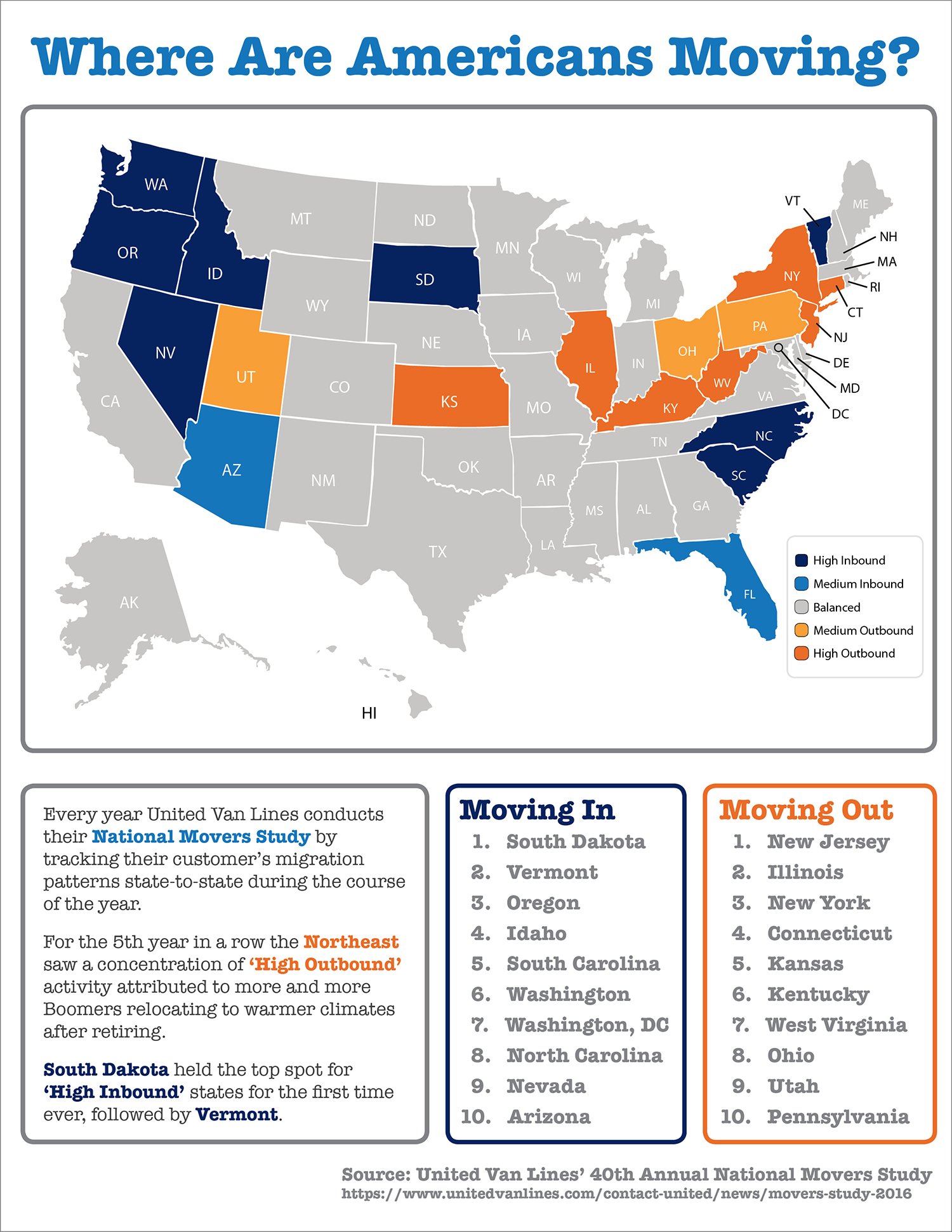
Where Did Americans move in 2016

Where Did Americans Move in 2016? | Simplifying The Market

Some Highlights:

  • For the 5th year in a row, the Northeast saw a concentration of “High Outbound” activity.
  • For the first time ever, South Dakota held the top spot for “High Inbound” states.
  • Much of America’s outbound activity can be attributed to Boomers relocating to warmer climates after retiring.

Will vs. Trust…Know the Difference?

estate-planning-corkboard1

Most people are not familiar with the differences between a will and a trust.  A will is only an invitation into a Probate proceeding and involves (1) 18-24+ months where all assets are frozen during the pendency of the probate proceeding; (2) exorbitant costs; (3) a sacrifice in personal time and energy; (4) stress.  In reference to costs, there is a statutory Probate fee schedule that always seems to shock people when they learn how this system works.  For example, if you and your wife own a home with a fair market value of $500,000-irrespective of the balance between how much you own and how much you owe, the Probate court assesses the gross valuation-the full $500,000, which equates to a minimum statutory assessed fee of $26, 000.  This does not factor in court filing fees, appraiser fees, creditor claims and attorney extraordinary fees, which invariably tack on multiple tens of thousands of dollars in most instances. An Estate Plan also ensures you avoid the expense and uncertainty of court proceedings otherwise required should either of you become incapacitated through illness, accident or a disability.  


Mark Swatik Esq. offers my clients a free consultation that is very helpful in educating them on the purpose of estate planning, as well as the privileges and protections associated with these concepts.

Contact me at tyson@american-california.com  to request a “free consultation”